1 Converter Design and simulation
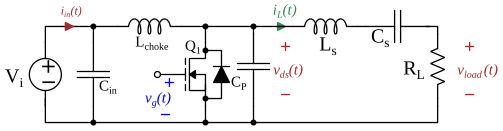
A simplified schematic of the Class-E RF power amplifier (Sokal and Sokal 1975) you will implement in the laboratory is shown in Figure 1.1.
1.1 Class-E amplifier design and initial simulation
Following the design guidelines discussed in the lecture, determine the component values required to design a Class-E inverter that meets the specifications listed in Table 1.1.
| Parameter | Value | Units |
|---|---|---|
| \(f_s\) | 6.78 | MHz |
| \(V_i\) | 12 | V |
| \(R_{load}\) | 5 | \(\Omega\) |
In the idealized Class-E inverter shown in Figure 1.1, the choke inductor \(L_{choke}\) is assumed to be very large, allowing the input current \(i_{in}(t)\) to be considered constant. In practice, however, a finite and realizable inductance must be used. For the Class-E inverter constructed in this laboratory, you may assume a choke inductance satisfying \[L_{choke}\geq 5\times L_s\]
For your design, assume that the gate drive signal \(v_g(t)\) is square-wave with sufficient amplitude to fully enhance the switch and a fixed duty cycle of 50%.
Complete the following tasks:
1.2 Matching network design and updated simulation
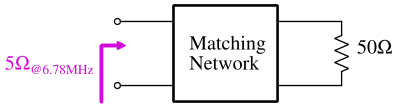
Although the class-E in Chapter 1 is designed for a \(5~\Omega\) load, a \(50~\Omega\) RF attenuator will be used in the laboratory to enable more accurate performance measurements. Consequently, you must design a \(6.78~\textrm{MHz}\), matching network that transforms a \(50~\Omega\) load to an effective \(5~\Omega\) load, as shown in Figure 1.2.
Update your LTspice simulation to include the matching network. Note that some elements of the matching network may be combined with the resonant components of the Class-E amplifier, thereby reducing the total number of components required.
Complete the following tasks: